
As it is known from the newspaper article that Fritz Neumann’s wife also worked as an artist, here are some references from the catalogue of copyright entries. More about this catalogue can be found in the corresponding article on Fritz Neumann .
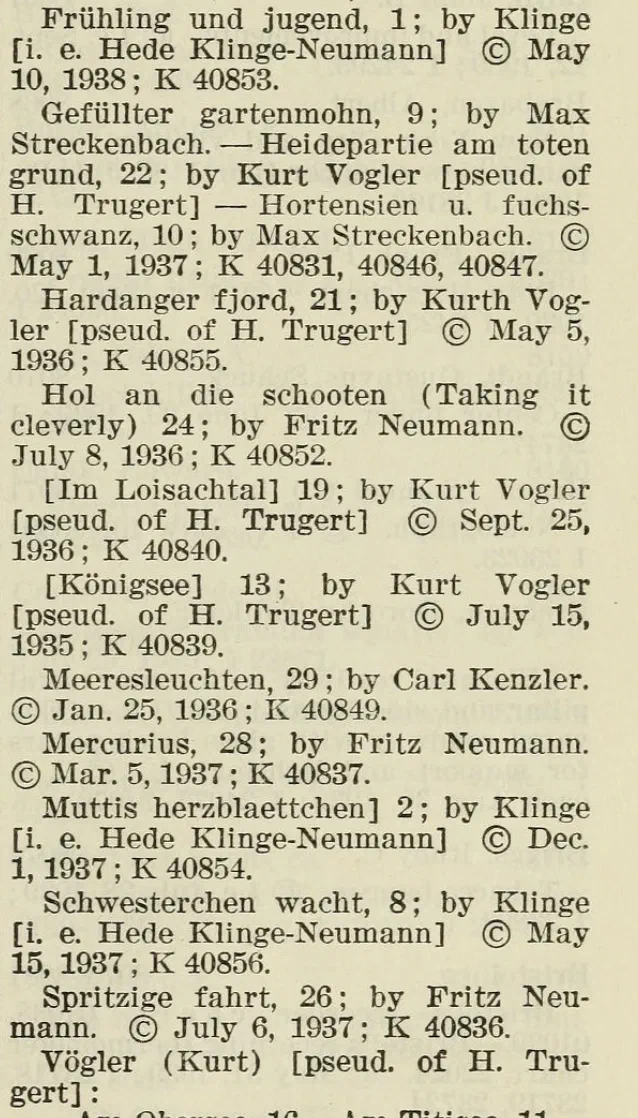
Catalog of Copyright Entries, New Series. Part 4: Works of Art 1939: Vol 34 No 1-4, page 143
Summary
| Work | Date |
|---|---|
| Frühing und jugend | May 1938 |
| Schwesterchen wacht | May 1937 |
| Mutties herzblaettchen | December 1937 |
The marriage certificate shows another address for Fritz Neumann: Lettestraße 1.
A search of the address reveals that it is most likely his father’s, Ludwig Karl Franz Neumann address, as there is an F. Neumann, book printer, sometimes also typesetter, can be traced there from 1904:
Address books
Address book 1904
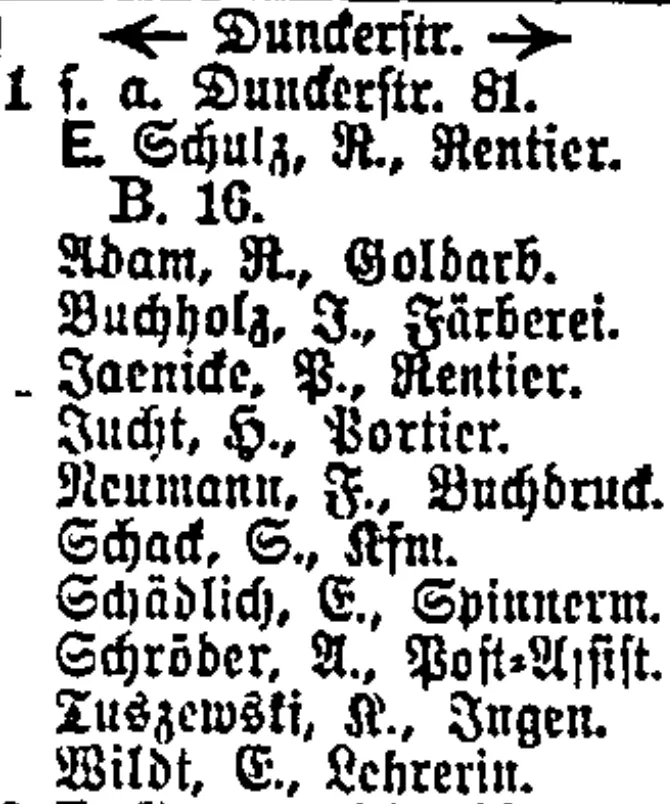
Address book 1904
Address book 1915
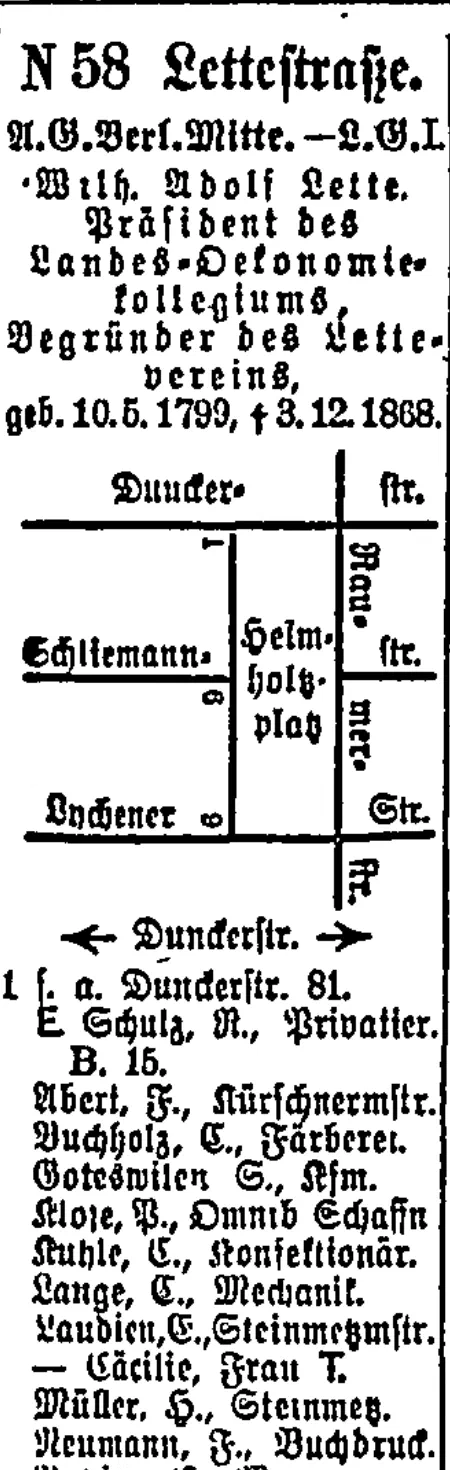
Address book 1915
Address book 1917
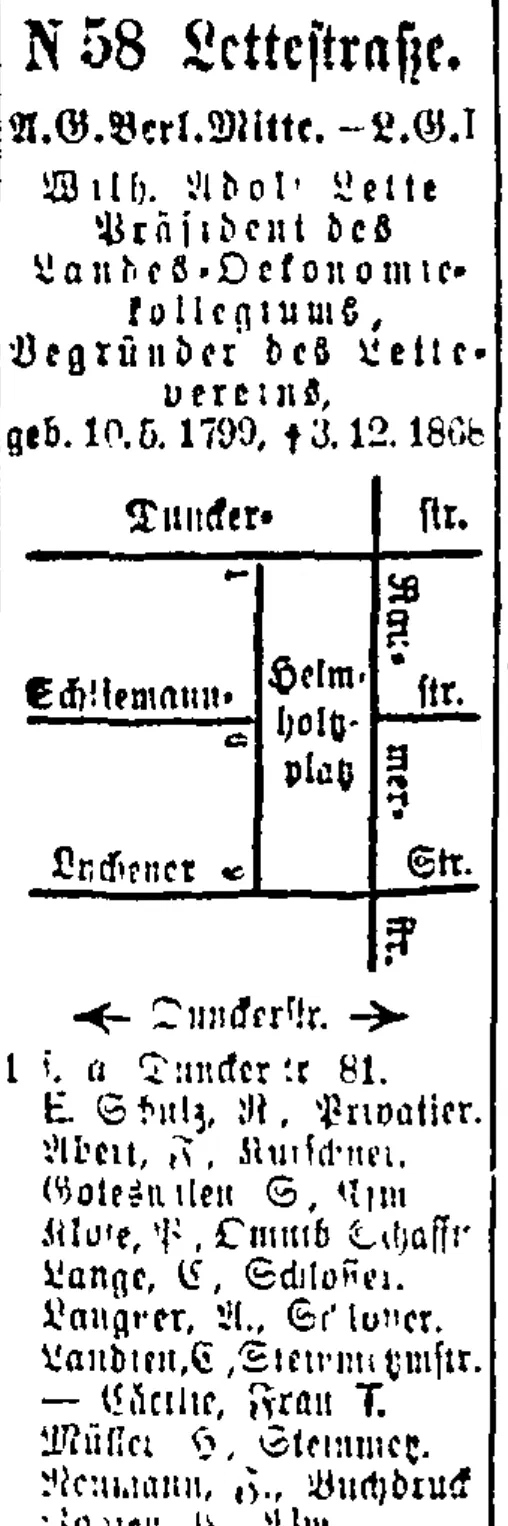
Address book 1917
Address book 1920
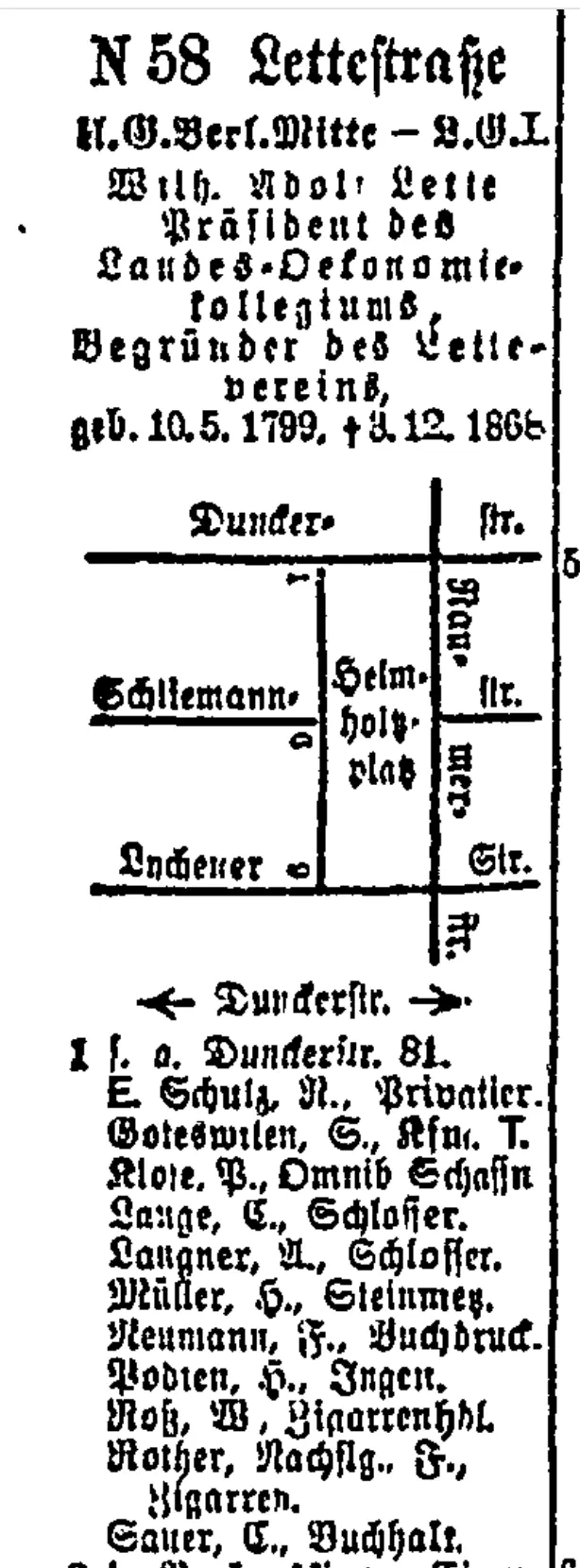
Address book 1920
Address book 1925
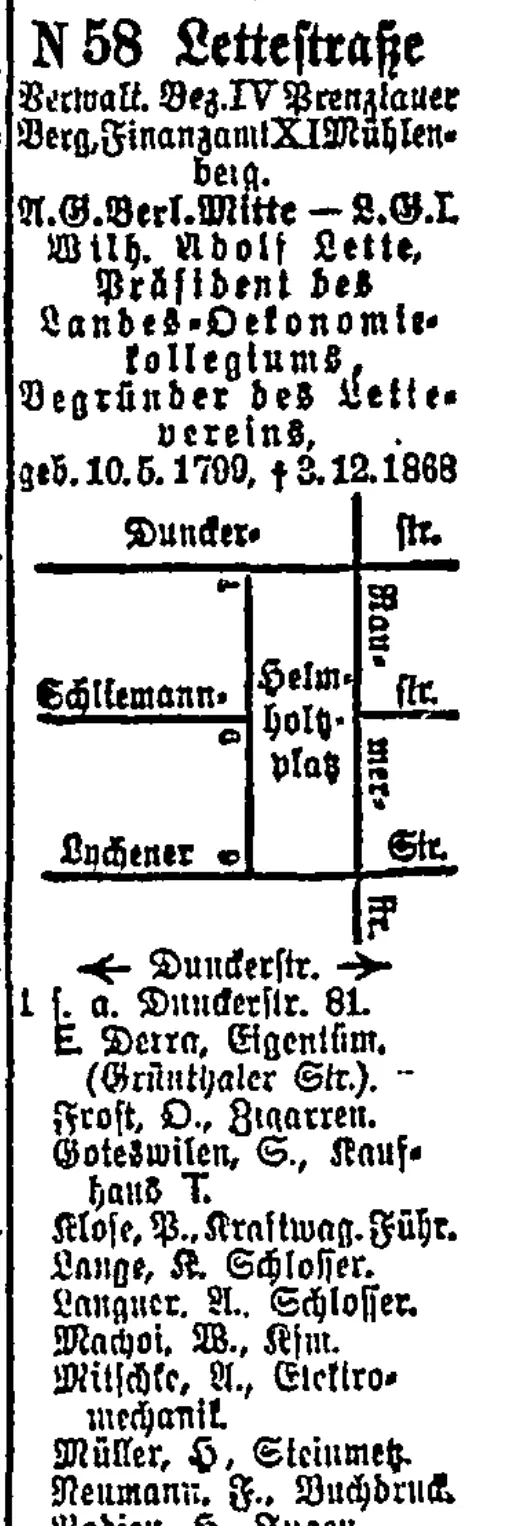
Address book 1925
Address book 1926
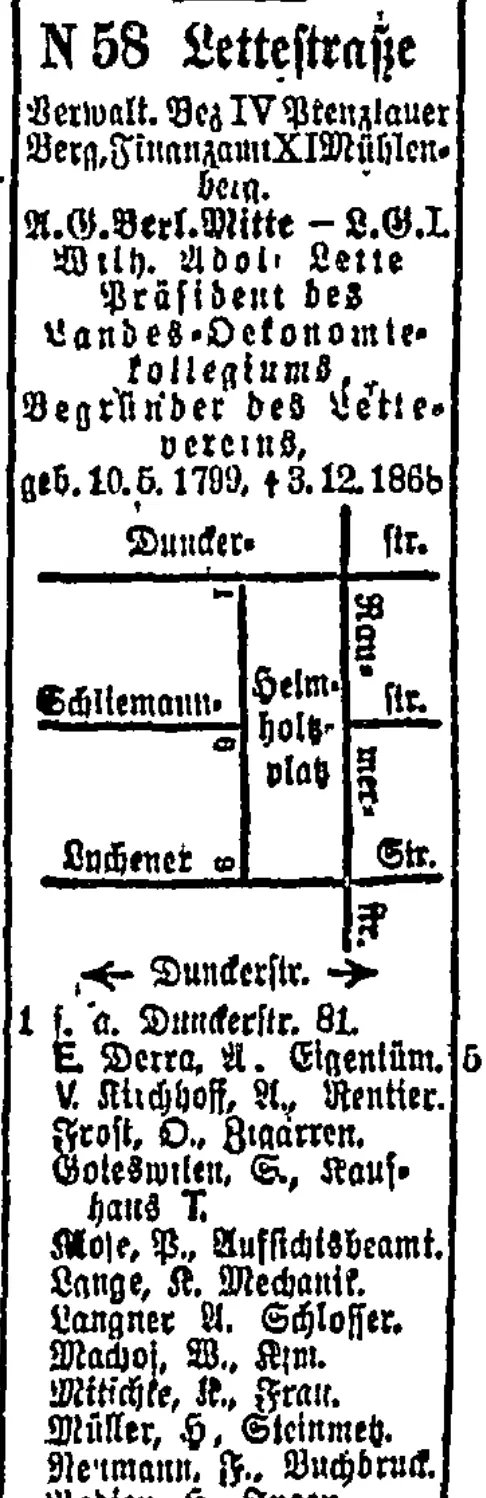
Address book 1926
Address book 1927
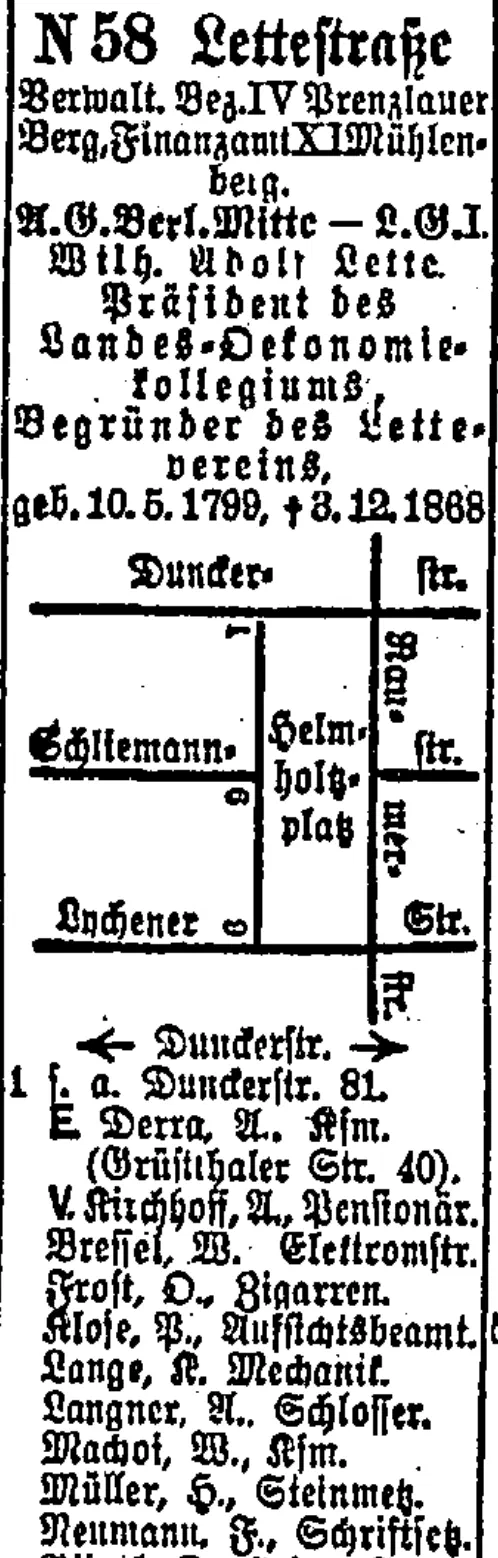
Address book 1927 - Als Schriftsetzer
Address book 1929
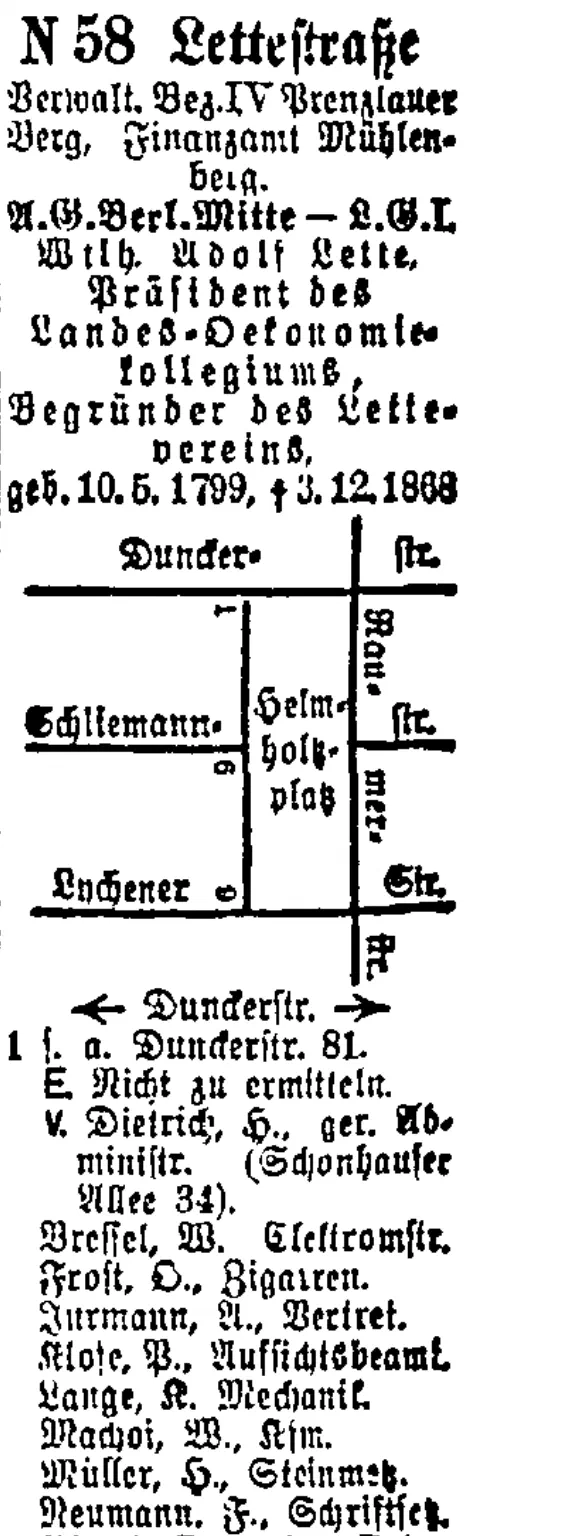
Address book 1929
Address book 1930
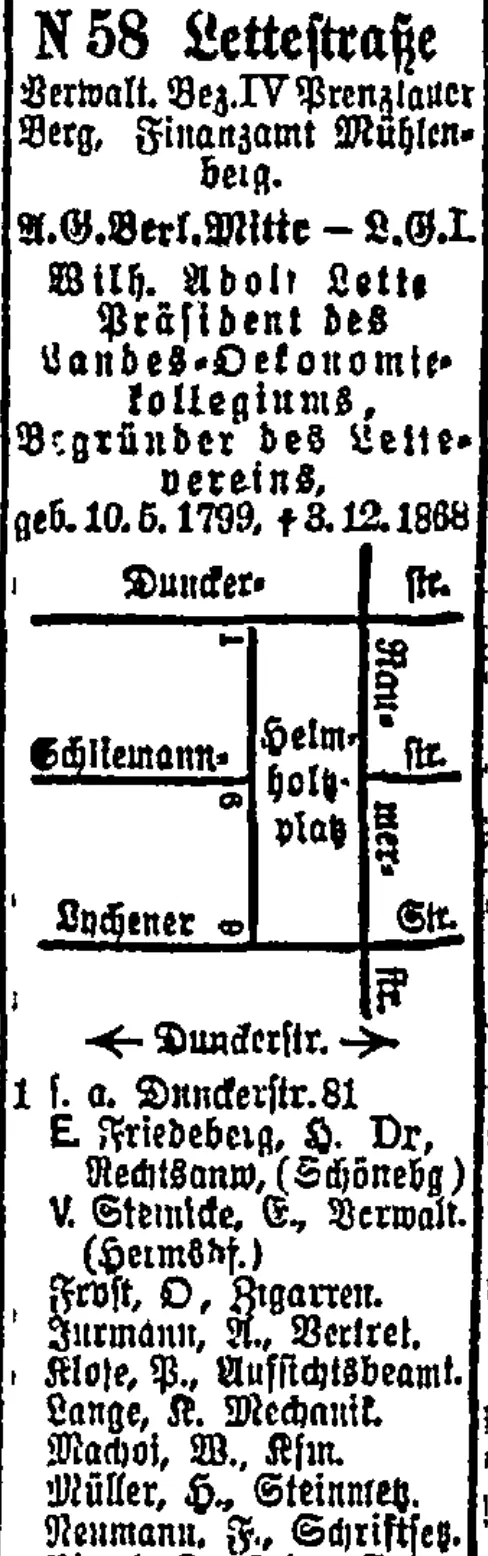
Address book 1930
Address book 1931
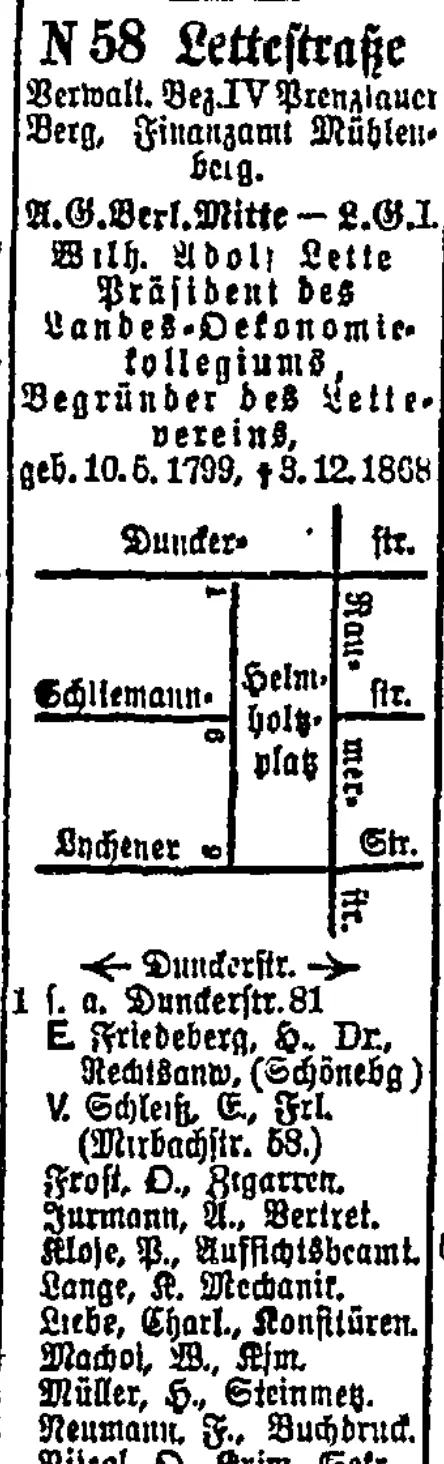
Address book 1931 - Wieder als Buchdrucker
Address book 1932
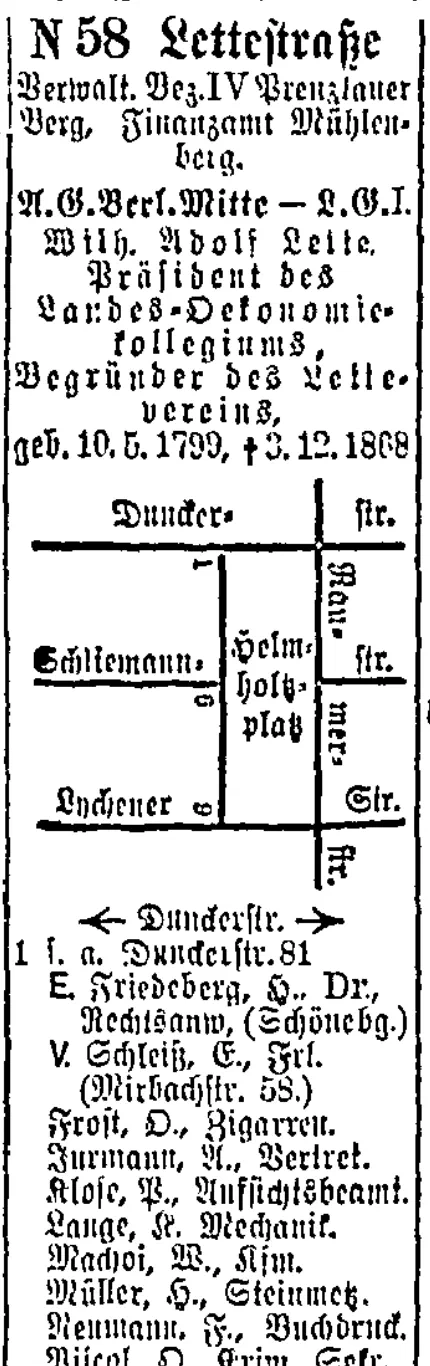
Address book 1932
Address book 1933
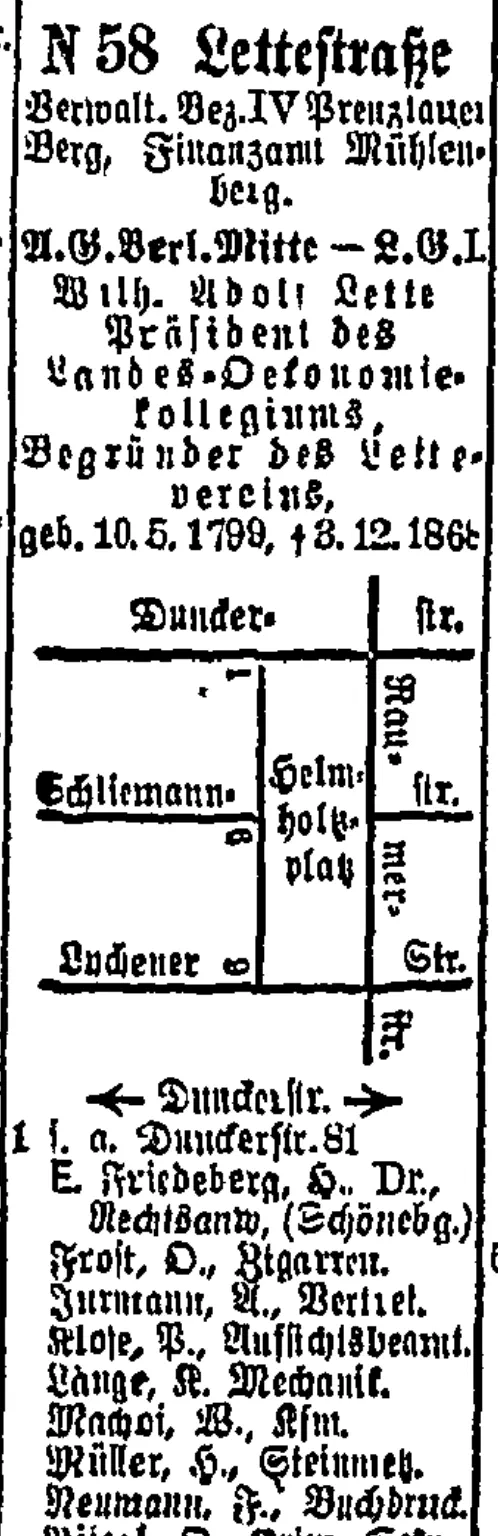
Address book 1933
This shows that Fritz Neumann’s father lived at Lettestraße 1 between 1904 and 1933 and worked as a typesetter between 1927 and 1931, otherwise as a printer. As Fritz Neumann had this address when he married, it can be assumed that he lived at home until 1925.
Sources
The digital copies of the sources are linked to the respective excerpts. As the URN:NBN resolver of the DNB is used, these can also be cited.
Name lists of the civil status registers
In addition, already known data can also be found in name directories of Berlin registry offices:
- Landesarchiv Berlin, P Rep. 221 registry office Berlin Xb Nr. 605 Name index birth register 1897, S. 167 -
- Landesarchiv Berlin, P Rep.806 registry office Berlin IX Nr. 658 Name index marriage register 1925, S. 33
Thanks to Evelyn Kraßmann for the tip.
The newspaper article in the Spandauer Volksblatt of 19 February 1972 shows that he attended an art school between 1912 and 1916. Now there is the first indication that he was enrolled for one semester at the Akademische Hochschule für die Bildenden Künste in the winter semester of 1912/13:
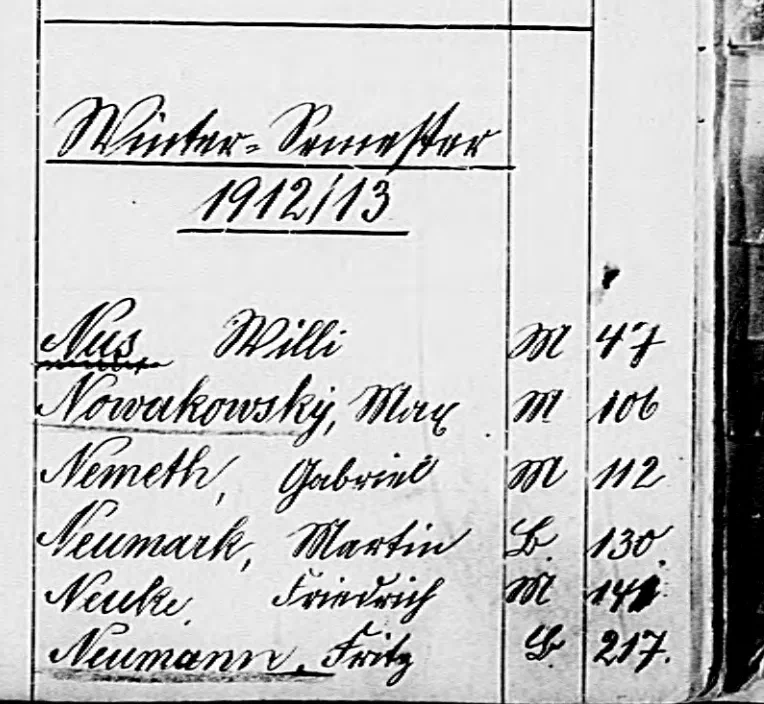
Entry on Fritz Neumann in the index of names for the winter semester 1912/13
The excerpt comes from the Alphabetical index of names WS 1909/10 to SS 1924 of the Academy of Fine Arts, page 92, shelfmark UdK Archive 6-204
Thanks to Dr Anastasia Dittmann from the Archive of the Berlin University of the Arts for pointing this out.
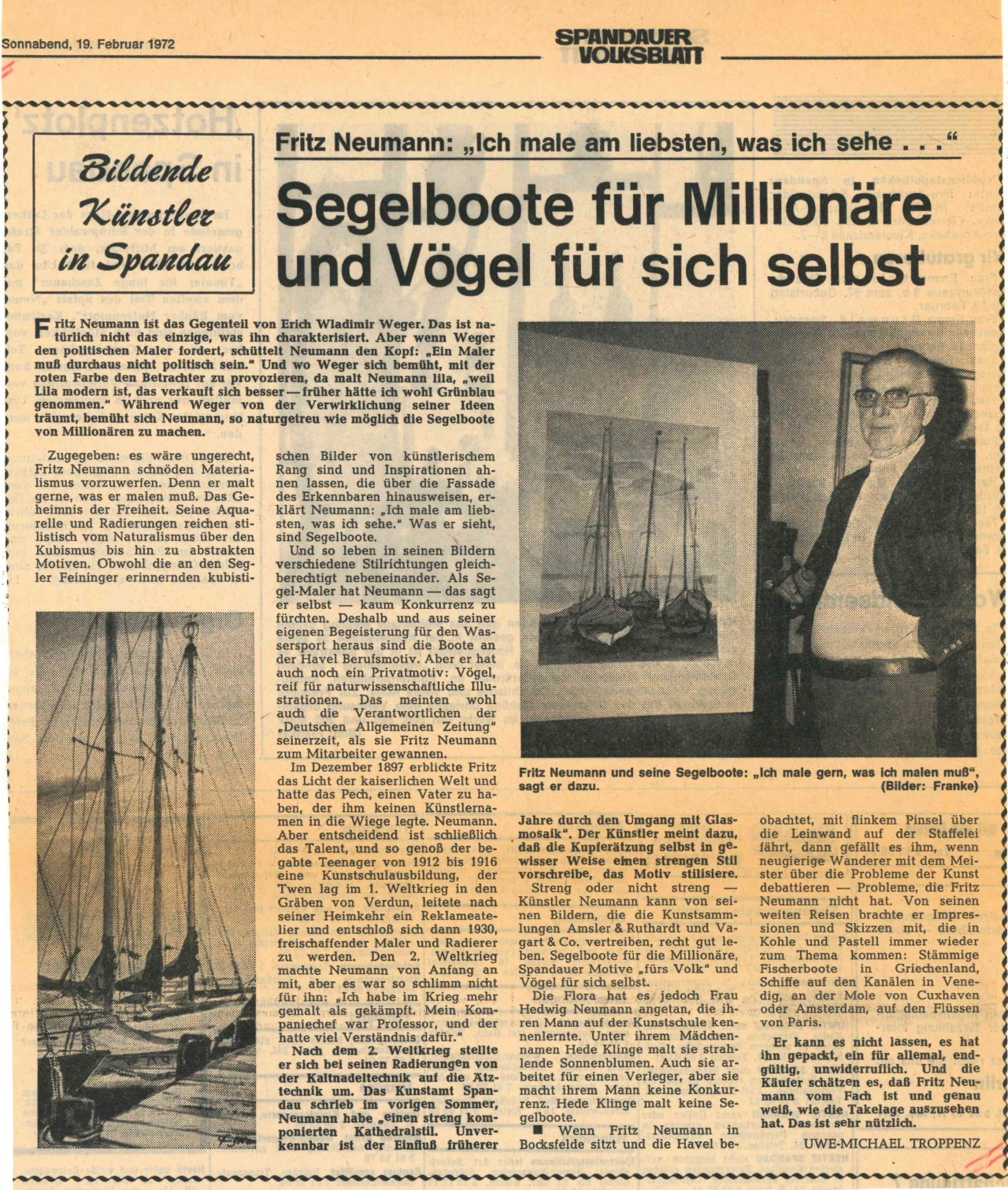
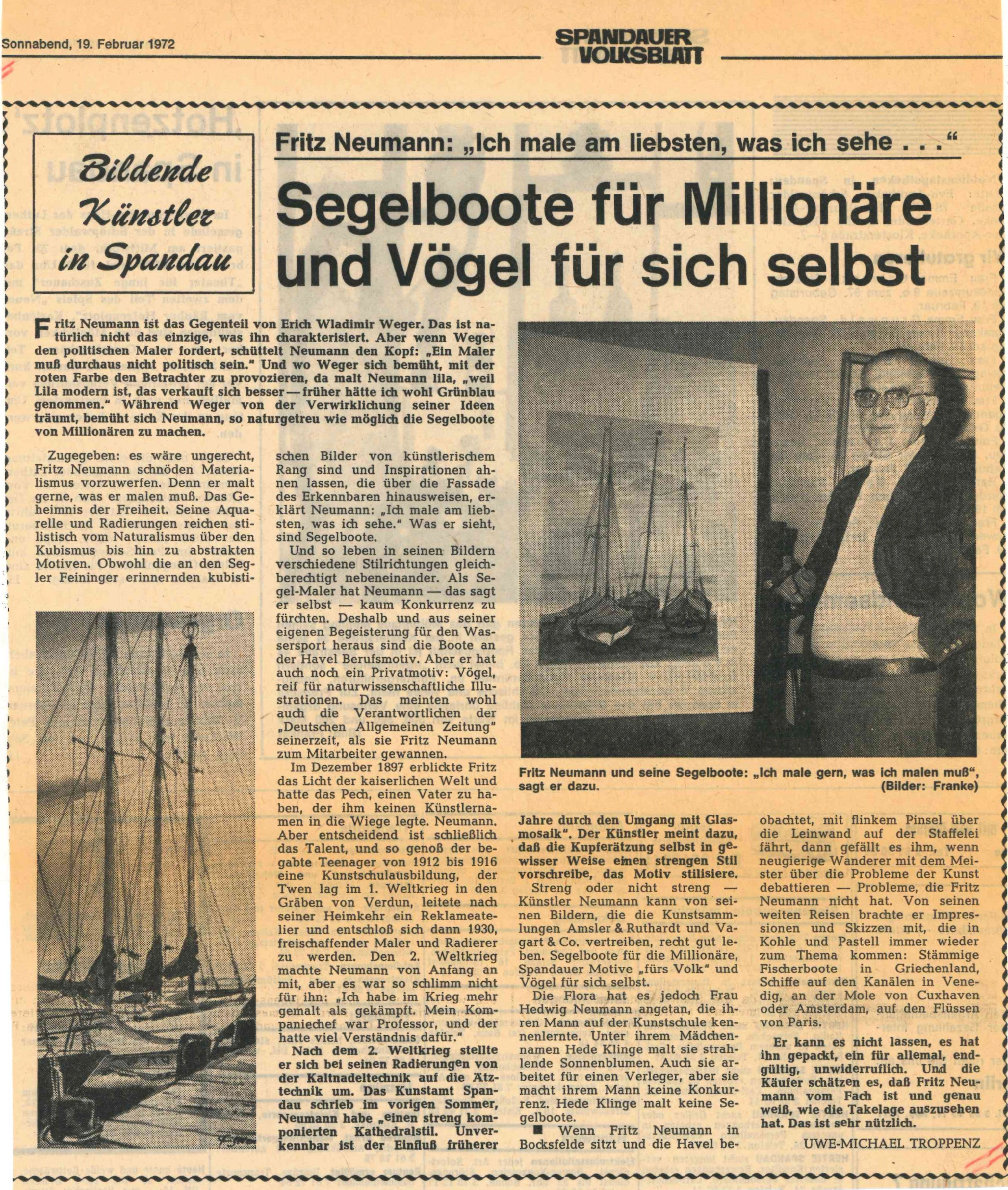
The article “Segelboote für Millionäre und Vögel für sich selbst” (Sailboats for millionaires and birds for themselves) by Uwe-Michael Troppenz from the previous post , published in the Spandauer Volksblatt on 19 February 1972, archive shelfmark IV C Z ZA PA 1038 (Archive of the Spandau City History Museum).
Transcription
Fritz Neumann: “My favourite thing to paint is what I see …
Sailboats for millionaires and birds for himself
Fritz Neumann is the opposite of Erich Wladimir Weger. But when Weger calls for a political painter, Neumann shakes his head: “A painter doesn’t have to be political at all.” And where Weger tries to provoke the viewer with the red colour, Neumann paints purple because purple is modern, it sells better - “in the past I would probably have used green-blue.” While Weger dreams of realising his ideas, Neumann strives to make the sailing boats of millionaires as lifelike as possible.
Admittedly, it would be unfair to accuse Fritz Neumann of disdainful materialism. Because he likes to paint what he has to paint. The secret of freedom. His watercolours and etchings range stylistically from naturalism to cubism and abstract motifs. Although the cubist paintings, reminiscent of Feininger the sailor, are of artistic merit and hint at inspirations that point beyond the façade of the recognisable, Neumann explains: “I prefer to paint what I see.” What he sees are sailing boats.
And so different styles coexist on an equal footing in his paintings. As a sail painter, Neumann - as he says himself - has little competition to fear. For this reason, and because of his own enthusiasm for water sports, the boats on the Havel are his professional motif. But he also has a private motif: birds, ripe for scientific illustrations. That’s probably what those responsible at the “Deutsche Allgemeine Zeitung” thought at the time when they recruited Fritz Neumann as an employee.
Fritz was born into the imperial world in December 1897 and had the misfortune of having a father who did not give him an artist’s name. Neumann. But talent is ultimately the deciding factor, and so the gifted teenager enjoyed an art school education from 1912 to 1916, the tween was in the trenches of Verdun during the First World War, ran an advertising studio after his return home and then decided to become a freelance painter and etcher in 1930. Neumann was involved in the Second World War right from the start, but it wasn’t so bad for him: “I painted more during the war than I fought. My company commander was a professor, and he was very understanding.”
After the Second World War, he switched from the drypoint technique to the etching technique for his etchings. The Spandau Art Office wrote last summer that Neumann had “a strictly composed cathedral style. The influence of earlier years is unmistakable in his use of glass mosaic”. The artist commented that the copper etching itself to a certain extent prescribes a strict style, stylising the motif.
Strict or not strict Artist Neumann can make a good living from his paintings, which are sold by the art collections Amsler & Ruthardt and Vagart & Co. Sailing boats for the millionaires, Spandau motifs “for the people” and birds for himself.
However, Mrs Hedwig Neumann, who met her husband at art school, was taken with flora. She painted radiant sunflowers under her maiden name Hede Klinge. She also works for a publisher, but does not compete with her husband. Hede Klinge does not paint sailboats.
• When Fritz Neumann sits in Bocksfelde and observes the Havel, swiftly running his brush over the canvas on his easel, he likes it when curious travellers debate the problems of art with the master - problems that Fritz Neumann does not have. He brought back impressions and sketches from his long journeys, which he repeatedly returned to in charcoal and pastel: Sturdy fishing boats in Greece, ships on the canals in Venice, at the pier in Cuxhaven or Amsterdam, on the rivers of Paris.
He can’t let it go, it has taken hold of him, once and for all, definitively, irrevocably. And the buyers appreciate the fact that Fritz Neumann is a professional and knows exactly what the rigging should look like. That is very useful.
UWE-MICHAEL TROPPENZ
Fritz Neumann and his sailing boats: “I like to paint what I have to paint”, he says. (Pictures: Franke)
Notes
- More about Erich Wladimir Weger
Thanks to Torsten Steinberg, we now have two civil register entries for Fritz Neumann. These are partly the source for the dates in the main entry .
Marriage certificate
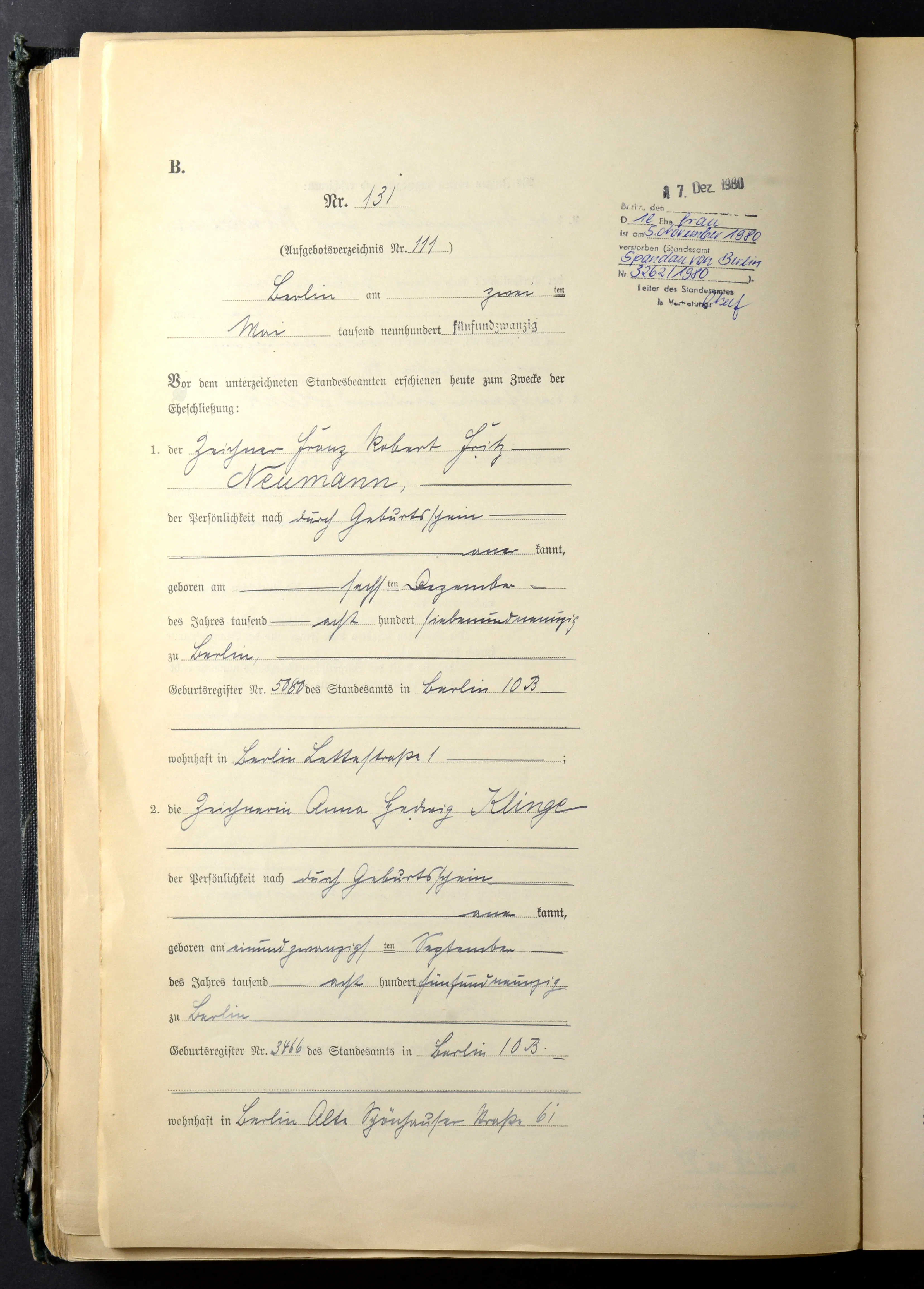
This is the marriage certificate of Franz Robert Fritz Neumann and Anna Hedwig Klinge, married on 2 May 1925. The occupation of both is given as “draughtsman” and “draughtswoman”.
Fritz Neumann’s birthday is given as 6 December 1897 and his address as Lettestraße 1.
Anna Hedwig Neumann was born on 21 September 1895 and lived at Alte Schönhauser Straße 61.
Source: Standesamt Berlin 9 (IX), Heiratsregister, Nr. 131/1925
Witnesses
Torsten Steinberg also adds the witnesses:
-
The craftswoman Erna Dombrowski, 30 years old, living in Berlin-Friedenau, Fregestraße 78.
Erna Luise Adele was born on 9.4.1895. On 16.3.1934 she married the senior teacher Otto Wilhelm Alfred Büchner (died 1952). Her profession at the time of marriage was draughtswoman. At the time of her husband’s death, they both lived in Bergmannstraße in Berlin.
-
Walter Klotz, 29 years old, a craftsman, lived at Viktoriastrasse 8, Berlin-Lankwitz.
Death certificate
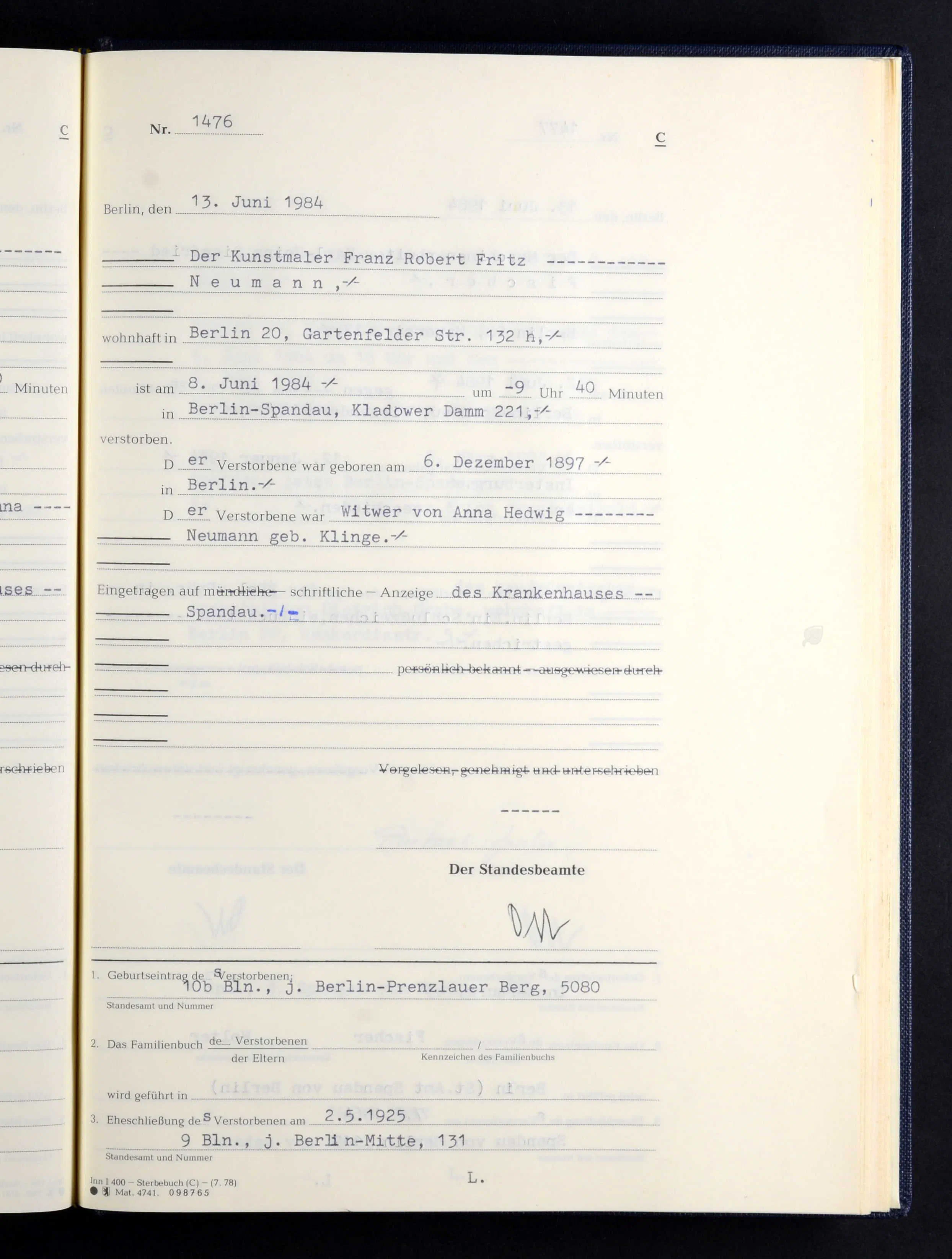
This is the death certificate for Franz Robert Fritz Neumann, painter. The address Gartenfelder Str. 132 h is the one known from the old address books .
He died on 8 June 1984 in Spandau Hospital.
In addition, the date of birth is given as 6 December 1897 and that he was the widower of Anna Hedwig Neumann, née Klinge, to whom he had been married since 2 May 1925 (see above).
Source: Standesamt Spandau von Berlin, Sterberegister, Nr. 1476/1984
After it turned out that Fritz Neumann (1928-2014) is not Ric , Mark Strong has updated the biographies at Meibohm Fine Arts and AskArt.com .
Many thanks to Mark for this!
Hopefully the false attributions on eBay and other auction sites will now be less…
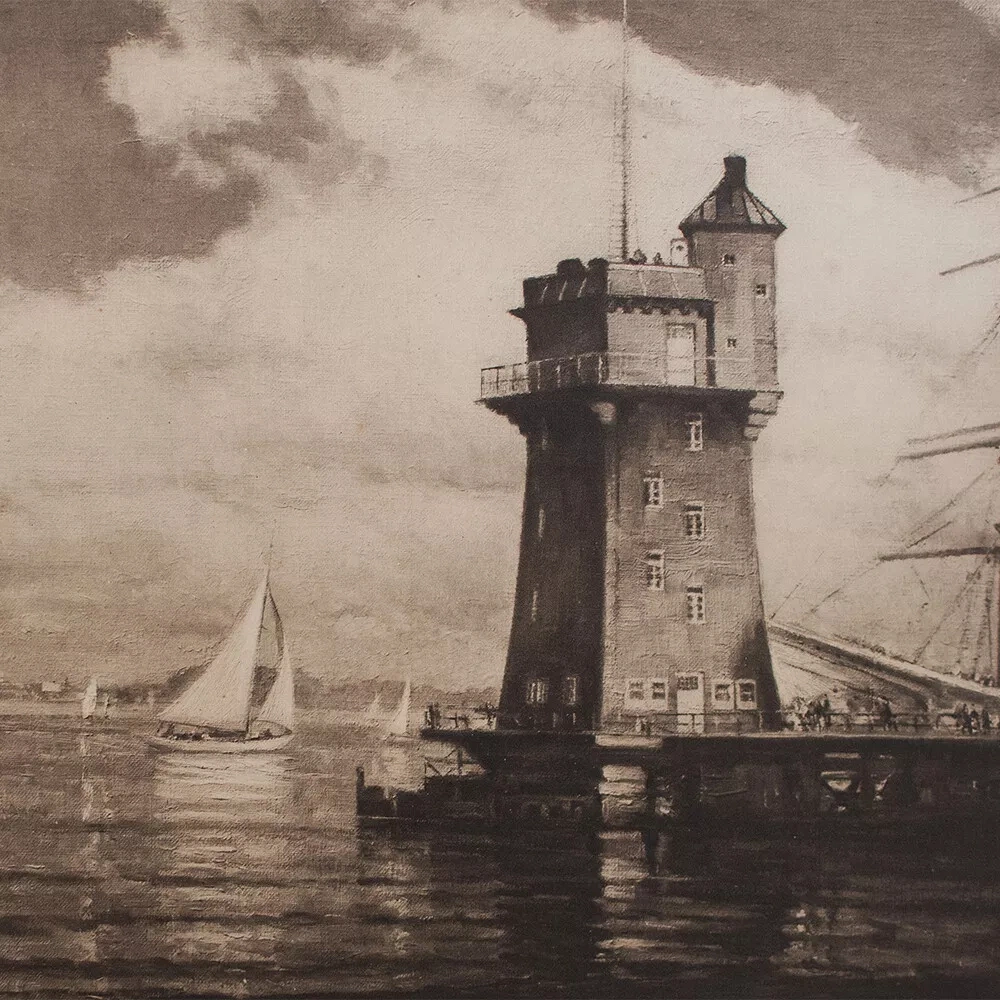
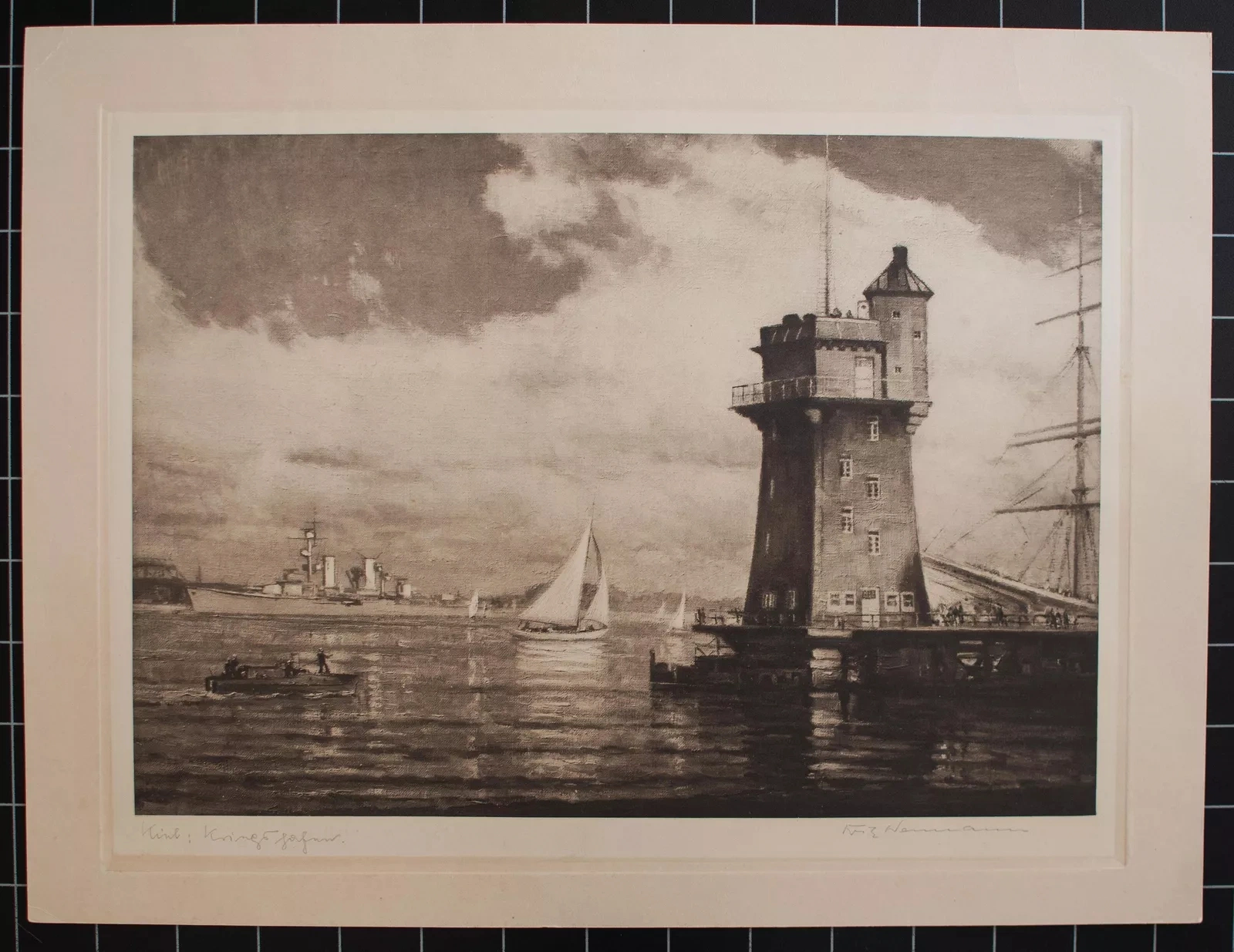
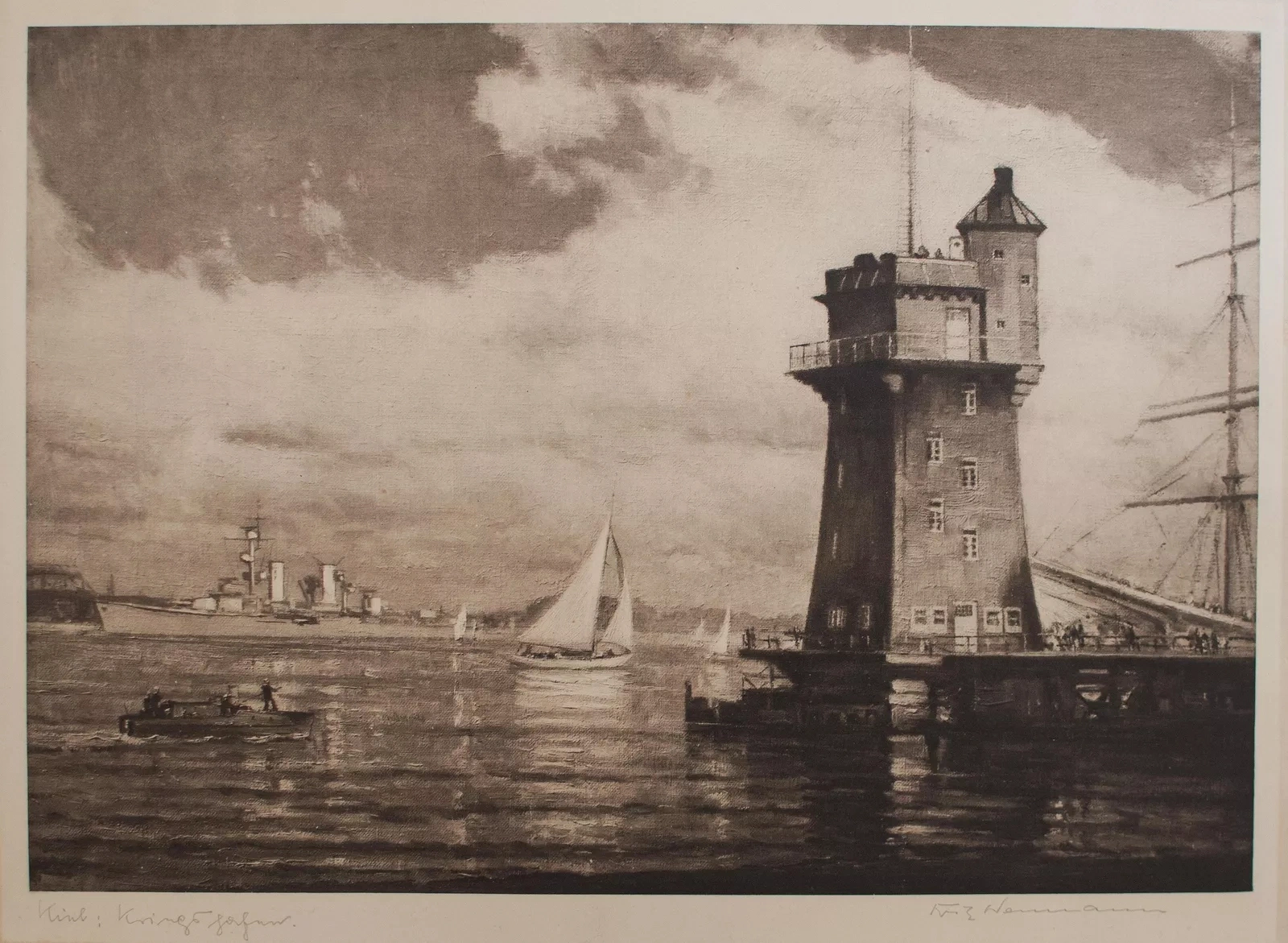
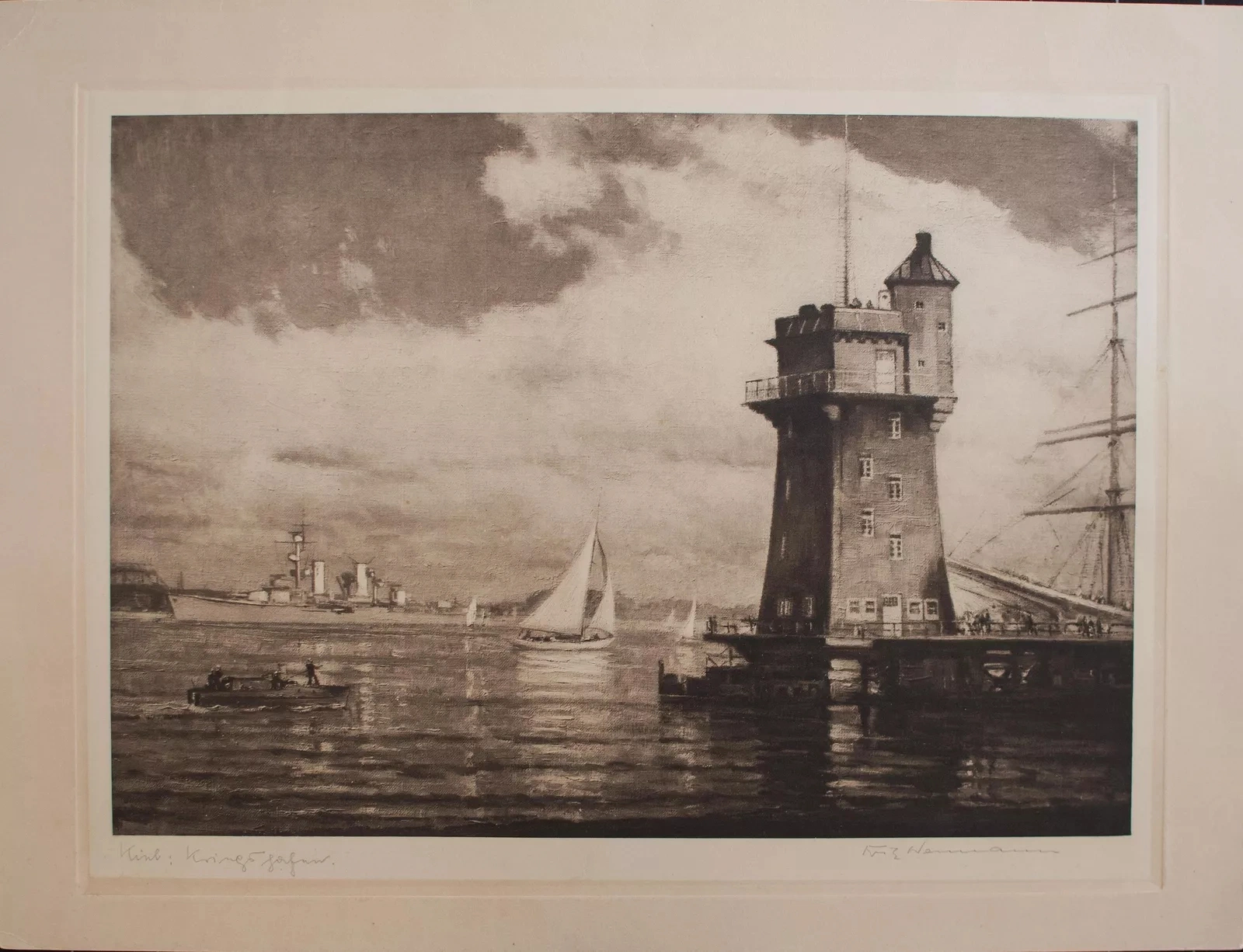
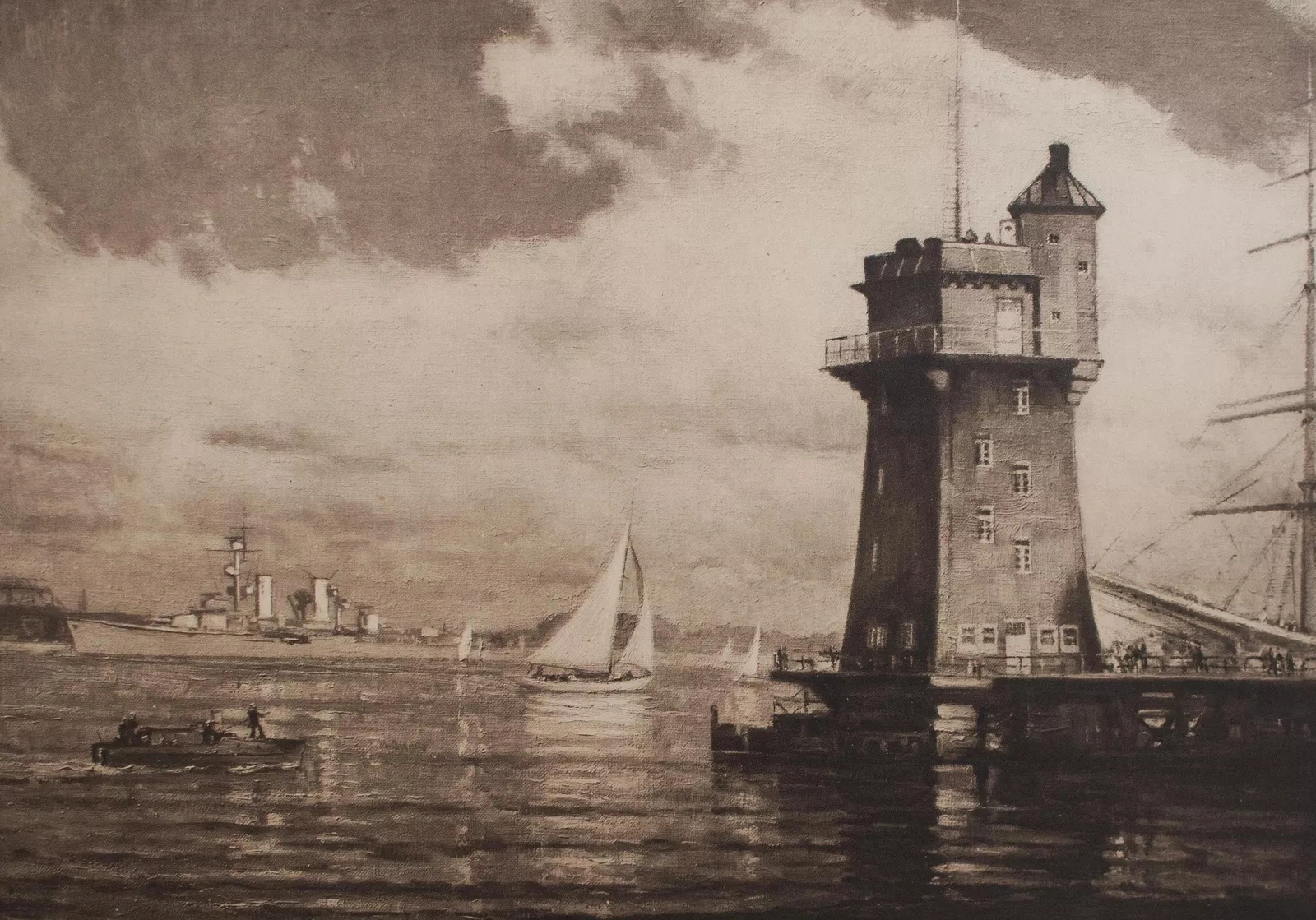
Short description: A etching of a the war harbour Kiel by Fritz Neumann.
Notes: Found on eBay . this has been brought to my attention by Torsten Steinberg. As he has noted this has almost certainly a wrong attribution: The stem points to a ship after the First World War, probably the Königsberg or a ship from the class , built after 1927, so the authorship of Hermann Fritz Neumann (1858 - 1920) can be ruled out.
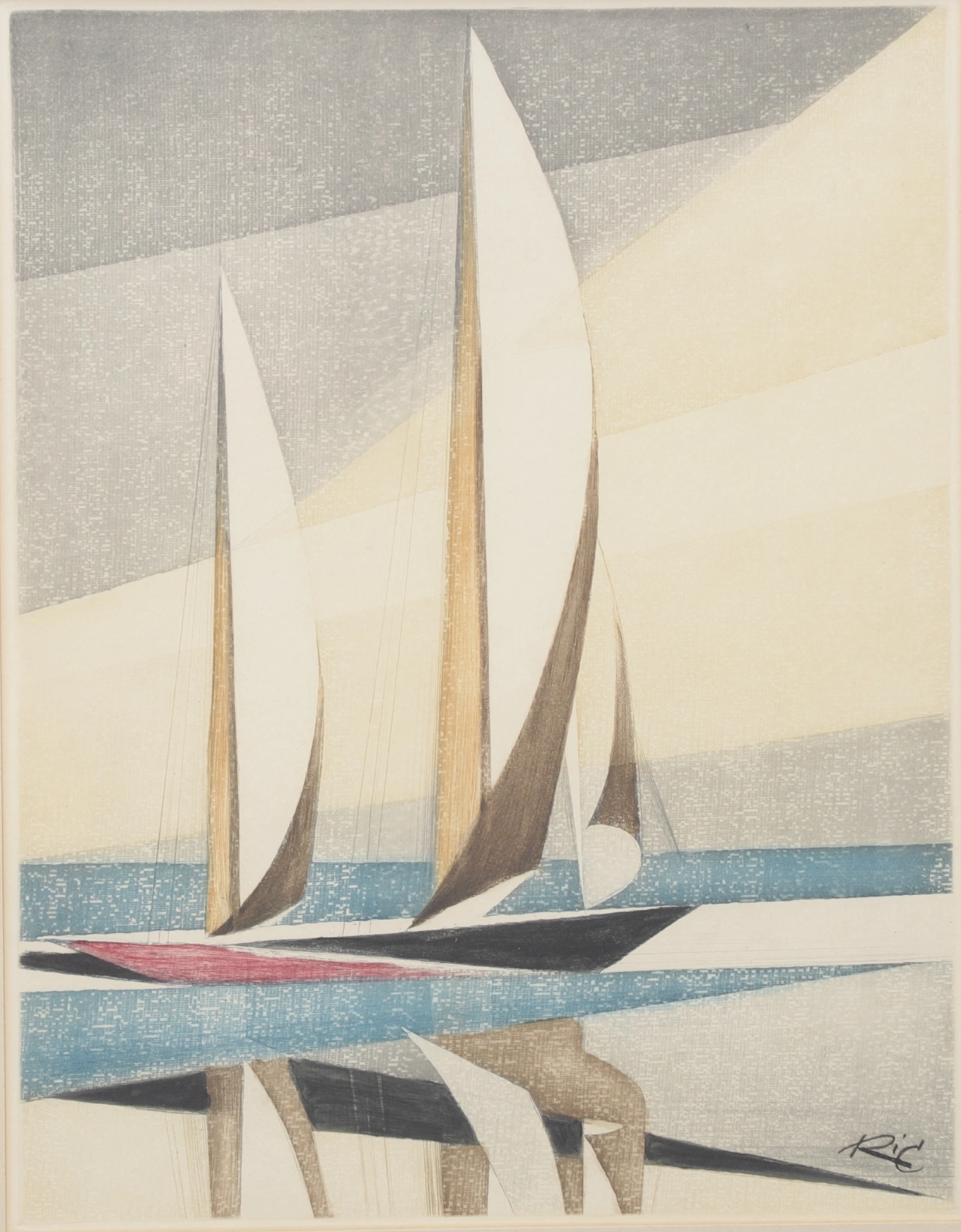
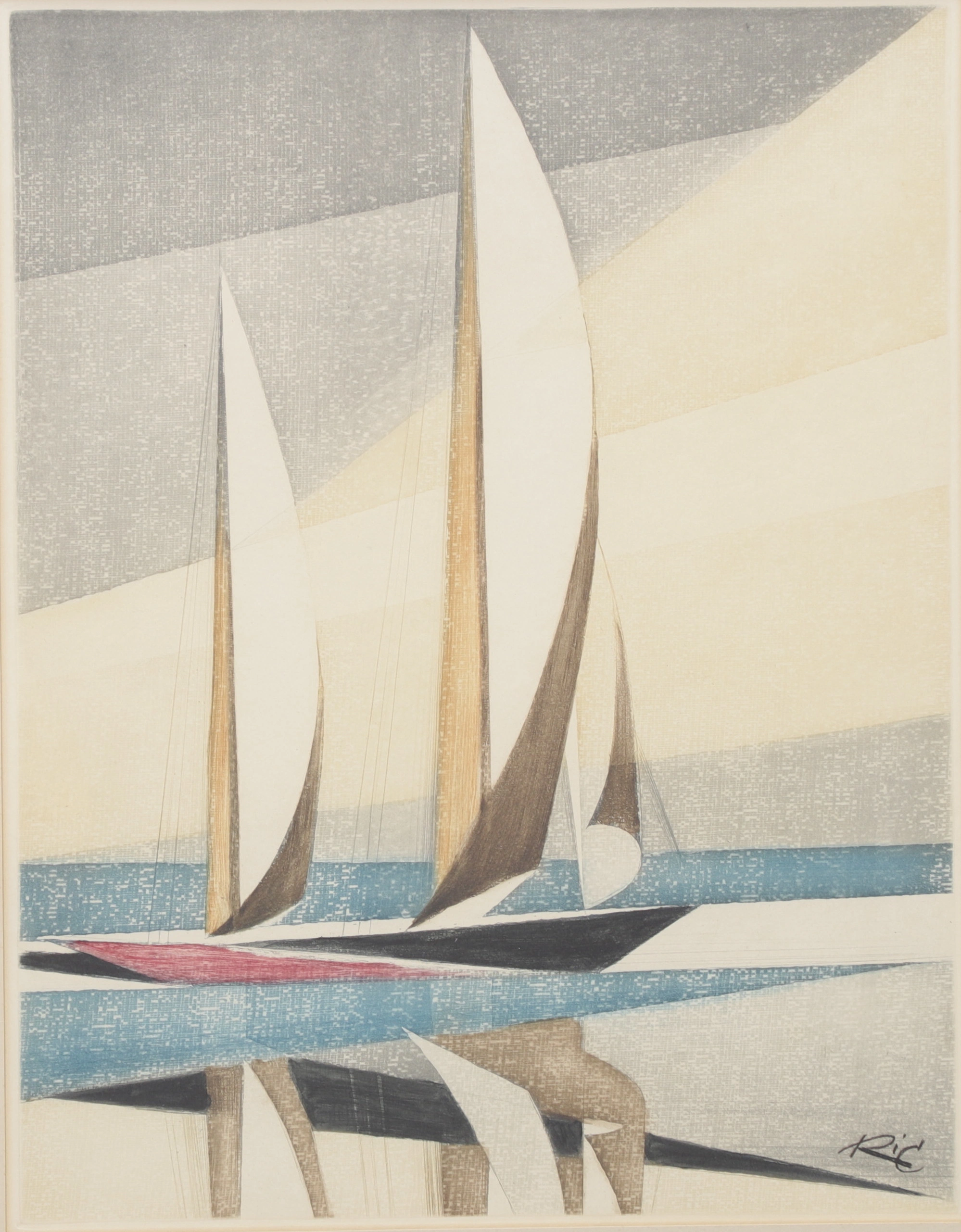
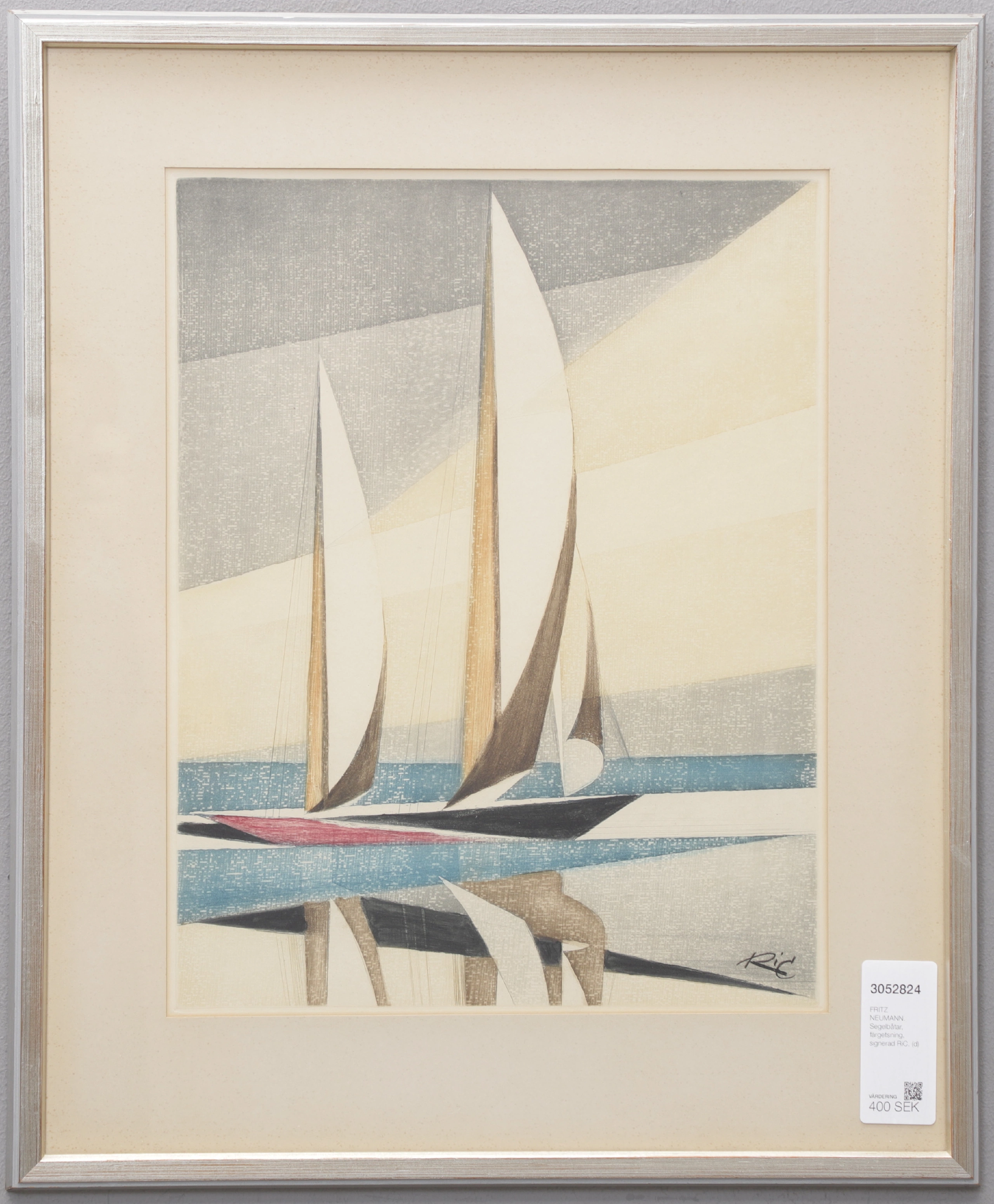
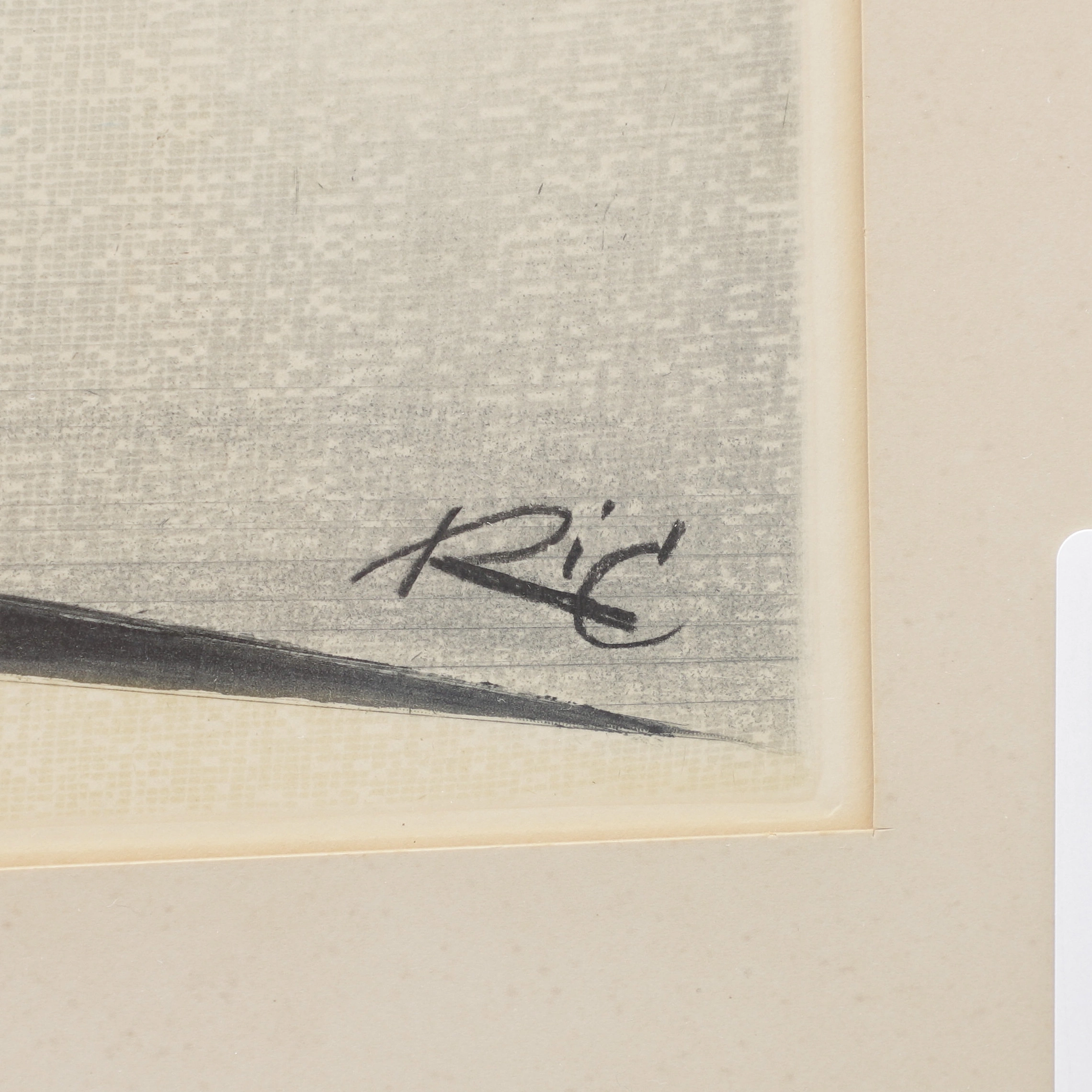
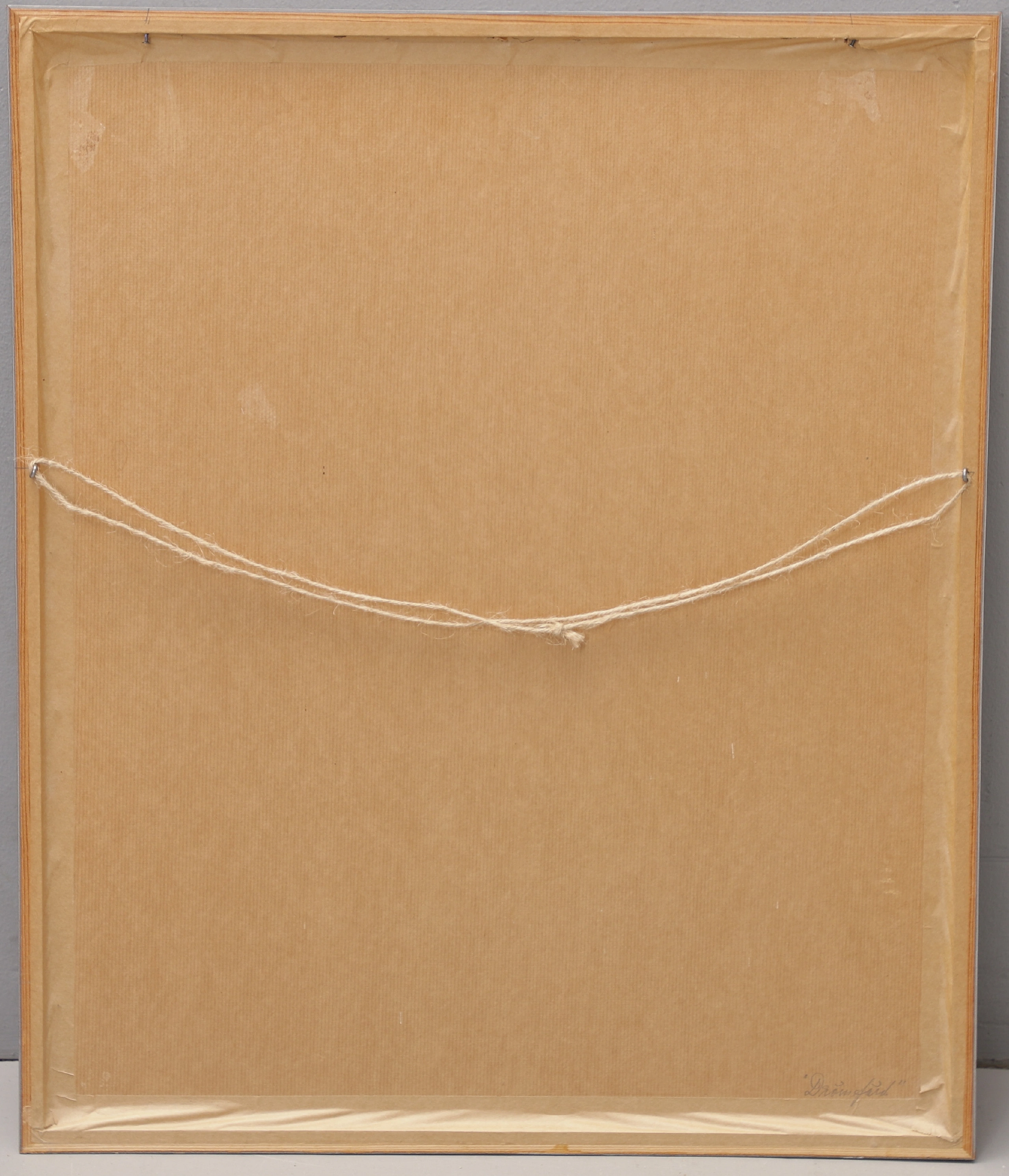
Short description: Sailing boats, known as Ric 05. This one has a unusual location of the signature - within the print.
Notes: Taken from auctionet.com .
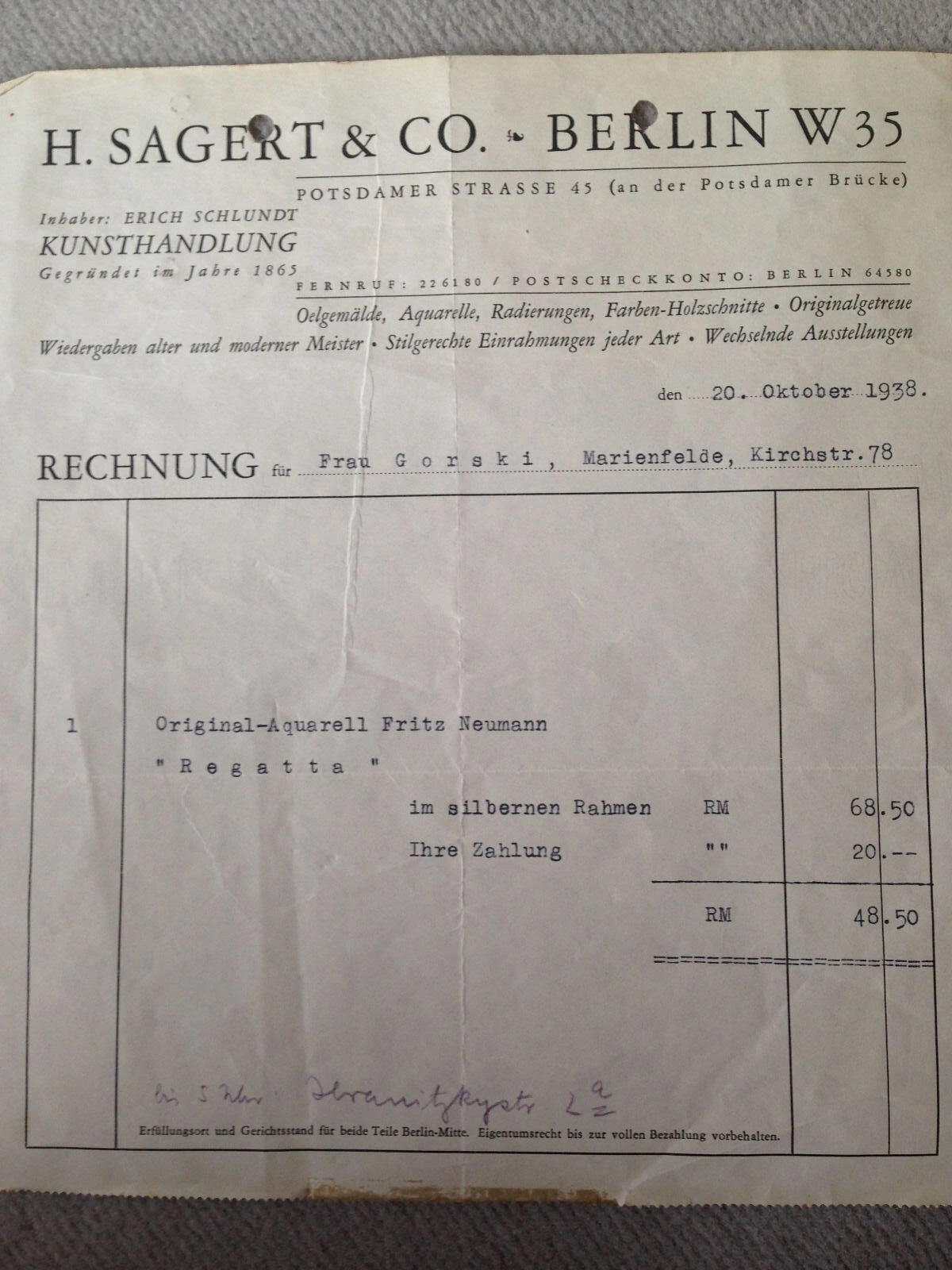
Another hint from Wolfgang Barina , an invoice for a Fritz Neumann watercolour painting called “Regatta” dated 20.10.1938.
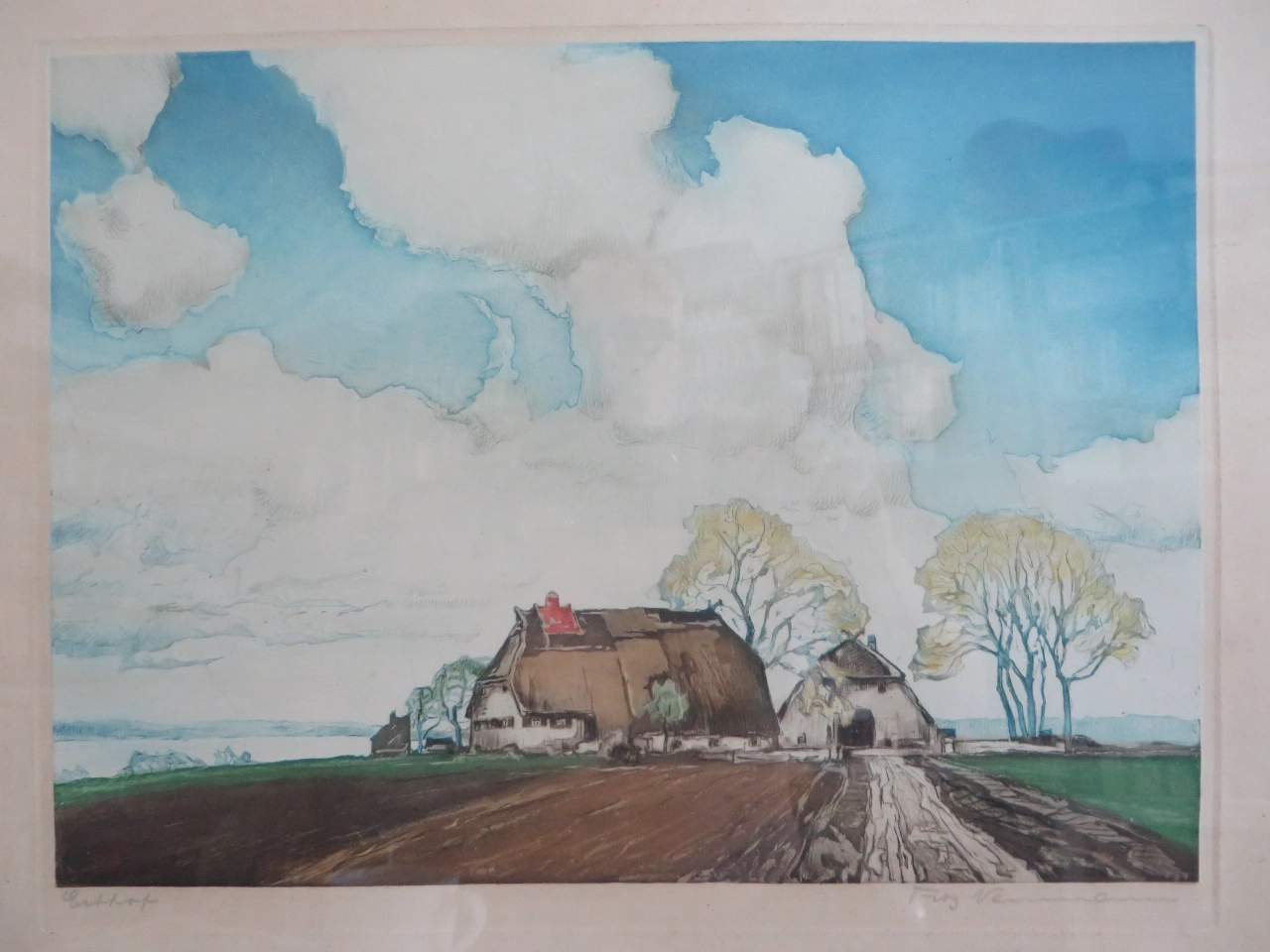
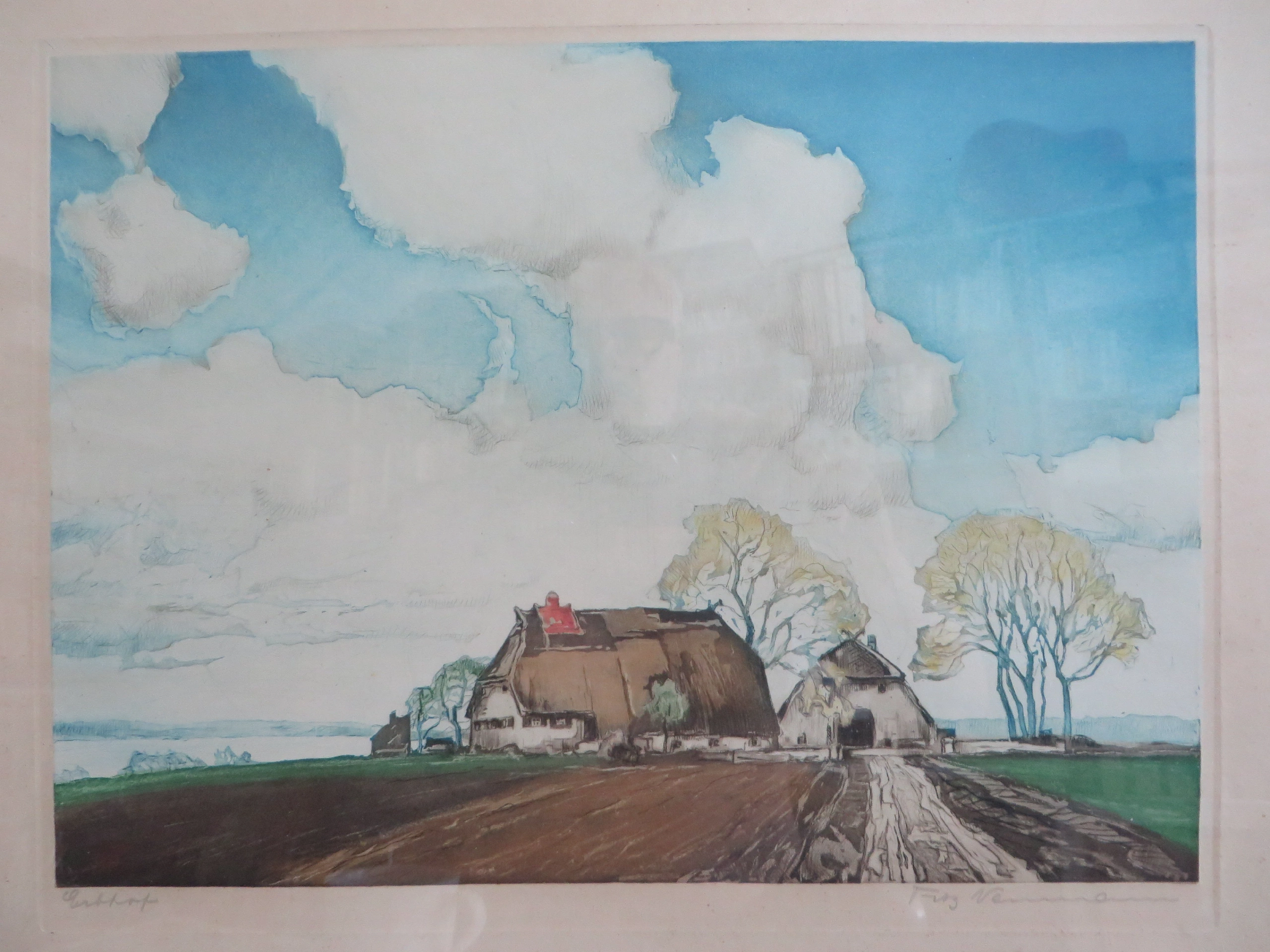
Short description: A colourised etching of a hereditary farm by Fritz Neumann.
Notes: There is also a print (certainly from a magazine) of this etching on eBay . Keep in mind, that those aren’t woodcuts!